Stuck in Traffic or Stuck in the Hub? Why Your Parcels Need AI logistics route optimization to Finally Arrive on Time
Why Does Your Parcel Always Get “Stuck” Just a Few Kilometers Away?
It happens to everyone. You shop online and follow the shipment closely. It travels from an international warehouse to the local sorting centre using customs, all appears good. After arriving at the local sorting centre, your app says “Your order is out for delivery”. All you can do now is wait at home for the doorbell to ring. The next thing you know it is dark outside and you’ve been waiting all day for the doorbell, which will never ring! If you are lucky, when you check your app again, you find a note saying “Delivery attempted. No success”. If your app’s update gets stuck at this point, you now have missing children and no idea what happened to the package!
- Why Does Your Parcel Always Get “Stuck” Just a Few Kilometers Away?
- What Exactly Are These “AI logistics route optimization” Algorithms Calculating?
- Does It Really Matter? How Companies Use AI logistics route optimization to Achieve “Cost Down”
- Avoiding the “Traffic Trap” from the Warehouse to Your Doorstep
- Do We Still Need to Wait for Parcels? The New Rhythm of Smart Automation
Unfortunately, this is not always the fault of the driver. In busy metropolitan areas throughout Asia, last mile delivery optimization is a difficult challenge for logistics firms. Take, for instance, the problem of having to deliver 100 or more deliveries in one day per rider. If they only use their memories and basic GPS, then they have a high probability of not having complete information to deliver the products successfully. One heavy downpour, or 30-minute highway traffic jam could easily affect all of their other deliveries for that day.
Typical logistics work as a simple ‘To-Do List’. Go from Point A to B, then C, and so on. Once you’ve got to the last point no more deliveries that day, complete! But if one has many points and the traffic can change every second, then humans cannot keep up with the number of factors involved. If AI logistics route optimization does not exist and are not used in the backend of logistics, the drivers become frustrated. They keep driving around the same area, wasting gas and other resources.
What Exactly Are These “AI logistics route optimization” Algorithms Calculating?
When someone hears the term “AI” or “algorithms,” they usually think of science fiction films. To the contrary, it is simply a “super brain” solving an incredibly complex mathematical equation. But rather than simply calculating the shortest route, AI also calculates the most efficient way to accomplish those routes.


AI logistics route optimization will take into account a number of variables that we typically don’t think about vehicle Constraints. Which can a very large truck fit in these small residential streets? Parcel Sensitivity, if this truck has frozen food that needs to be the first item delivered, it needs to be on top of the pile. Time Windows, if an office building closes at 5 PM sharp, the delivery must arrive before then. Real-Time Events, if there is an accident ahead of the vehicle, can the system re-route the entire fleet to avoid delays?
This is called dynamic route planning. In the past, when a driver found out that a road was blocked, the driver would have to stop, consult a map, and contact their employer. With AI, an alternative route will be available in a matter of seconds. BidaTech AI is one example of a technology partner that can provide this type of support to companies that want to have “smart brains”. Which without having to spend money creating a complete solution from scratch. Using logistics optimization algorithms, logistics companies will stop blindly adding new vans and begin making existing vans as efficient as possible. Using this process helps to create and develop more efficient deliveries. It’s about making sure the business doesn’t bleed money on wasted mileage.


AI Logistics creates a win-win loop
Implementing AI logistics route optimization isn’t just about speed; it’s about reliability. When systems balance fuel cost, traffic data, and driver fatigue, the entire supply chain route efficiency improves, leading to lower operational costs and happier end-consumers.
Does It Really Matter? How Companies Use AI logistics route optimization to Achieve “Cost Down”
Profit margins are very narrow in logistics. This means that every penny counts; petrol, tolls and maintenance – everything! If a van could save only 10 km per day of unnecessary driving and you had 100 vans in your fleet, you could save a tremendous amount of money per month.
Therefore, it is no surprise that there is so much talk about reducing costs in the way logistics operate. The main change to logistics is that AI has now taken away the time-consuming process of dispatching by providing dispatch optimization through AI technology. In the past, a dispatcher would spend two hours every morning sorting through manifests and making route adjustments. Now by using AI technology, hundreds of orders will be automatically scheduled in a matter of seconds.
The second major advancement with AI in Logistics is the ability to do predictive logistics analytics. AI uses historical data from the last several months. AI also can see when a certain location has become congested every Friday afternoon. Therefore, AI automatically schedules those deliveries for Friday morning. This level of foresight provides a greater level of efficiency and creates a better experience for your drivers, customers, and your company’s bottom line.
Avoiding the “Traffic Trap” from the Warehouse to Your Doorstep
We are always afraid of seeing that dreaded “Red Line” on Waze. Delay means everything for a logistics company; a minute of delay sets off a chain of events. If a lorry carrying cargo arrives at the first destination and does not have the warehouse-to-delivery process in place, it will delay the remaining 99 destinations.


Today with AI traffic routing in real-time, routing systems can detect how traffic lights sync with city traffic systems. For example, how long a red light remains green or how far away from a construction site you will be when you reach a destination. AI is now so accurate in estimating arrival times; some tracking apps will say, “The driver is 3 stops away”. This is due to the massive amounts of backend data analysis required to provide such accurate predictions.
Fleet management systems utilizing AI are becoming a necessity for larger corporations. Manual mileage logs and timecards are not used as they used to be. Everything is data driven today. Using fleet management technology, you can easily see which driver was able to deliver their load with the least amount of fuel costs. By optimizing the logistics network, you can take your chaotic delivery system and transform it into a precise assembly line of deliveries.
Do We Still Need to Wait for Parcels? The New Rhythm of Smart Automation
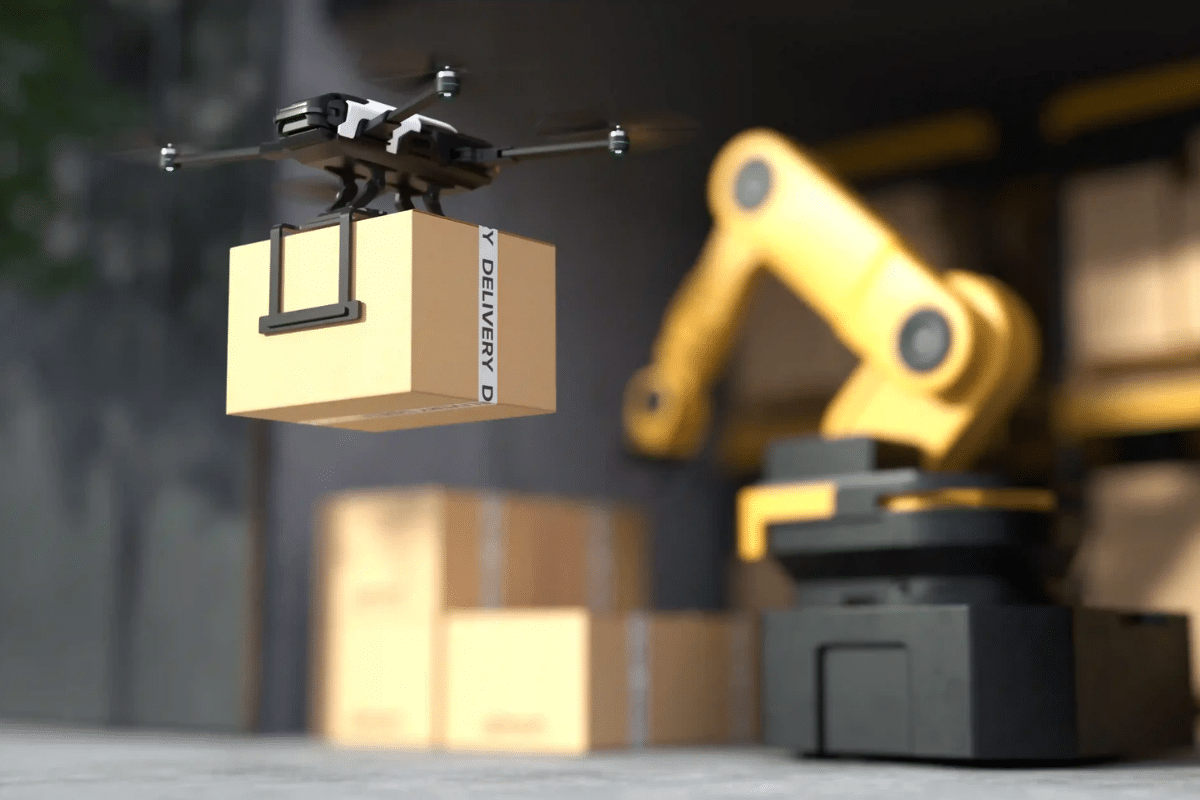
It may seem too soon to call drone-based delivery to your door a reality. But the pace at which logistics automation is advancing is remarkable. We are entering a revolutionary new era of supply chain management powered by AI. Instead of determining how to move a parcel from point A to point B, logistics companies are determining how to move a parcel from point A to point B. When the moments consumer orders it. Increasingly, using artificial intelligence and sophisticated algorithms, some logistics networks can predict demand and preemptively move products to a location near you before you even hit the “Buy” button. As a result of this new level of connectivity, the typical 3-5 days to receive a delivery has. In some cases, been compressed to same day delivery.
Along the journey to get to this new paradigm in logistics, technology enablers such as BidaTech AI are helping to drive this transformation of traditional companies. While not every small or medium-size company has the bandwidth to hire a large data team. Many companies are beginning to leverage existing AI solutions. As a means to make their delivery offerings as competitive as companies like Grab and Shopee. Logistics has fundamentally been a race to complete a delivery before the consumer needs an item. With AI in logistics, one benefit to consumers is that the “Parcel Delivered” notification may finally arrive before you finish your lunch.