Wait, Is Your Factory Running on “Vibe” or Data? Why AI Smart Manufacturing Operations is the New Normal for Asia’s Workshops
Why does running a workshop still feel like a daily fire drill?

Whenever you enter a manufacturing facility, especially in places. Such as Klang, Penang or industrial areas such as Johor, you will always notice the same rhythm. The environment is loud, busy and sometimes chaotic. Supervisors generally have to yell over machines that suddenly decide not to cooperate. Their managers study the white board trying to determine why an urgent shipment was delayed. All of us have experienced this at one time or another. For decades we have relied on our “Sifu’s” intuition. Their skill and knowledge allow them to have an immediate sense of when a machine may fail simply by hearing the sounds it is making.
- Why does running a workshop still feel like a daily fire drill?
- AI smart manufacturing operations Can machines actually tell us they’re “feeling sick” before they break?
- How does AI smart manufacturing operations fix the “too much or too little” inventory headache?
- Is AI smart manufacturing operations going to take away the jobs of our local workers?
- What does the future look like for a small workshop that decides to go “Smart”?
One of the biggest challenges to scaling operations is that with more complex orders and more demanding customers. We cannot rely solely on intuition anymore. This will provide the foundation for AI and smart manufacturing capabilities to exist, continue to support the people with experience and knowledge on the shop floor and enable them to better understand their operation and predict where to find future bottlenecks.
When many businesses think about modernising their operations – many think of simply adding a new robotic arm. However, if the robotic arm is controlled by a “brain” from 1995 – you will only produce errors more quickly. Information processing is the biggest game changer in automation. For example, instead of stating “I think we have enough supplies,” – the system will provide “we need this amount of supplies and we will have them for our next order next Tuesday.”
AI smart manufacturing operations Can machines actually tell us they’re “feeling sick” before they break?
An unanticipated breakdown in production is any engineer’s worst nightmare! You are on a timeline, trucks are waiting, and suddenly everything comes to a standstill. The most important machine on your line has failed due to an overloaded motor. You now find yourself in a situation where you will have to wait days for replacement parts and lose thousands of dollars in revenue. This is why predictive maintenance is gaining popularity within manufacturing.



Traditionally, we can either fix breakdowns once they occur (reactive maintenance) or replace all parts after a predetermined period of time (preventative maintenance). Both methods are very costly. With the integration of industrial IoT sensors, we are now able to retrofit our entire plant with inexpensive, small sensors placed on older equipment. These sensors will listen for vibrations, track temperature, and monitor electrical current consumption.
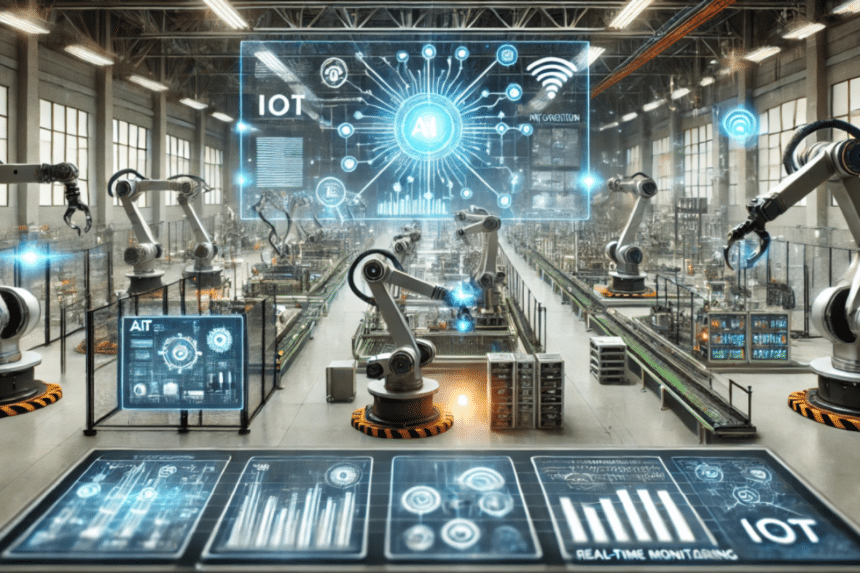
As we gather more and more data for process improvement projects, we will teach these solutions how to identify what the “normal” sounds for each piece of equipment are. When the system detects even a small variation from its established baseline. They often too slight to detect by an individual’s hearing – it logs the error. It’s similar to how your vehicle will tell you exactly which spark plug will fail within the next 500 km of travel. By identifying problems at this stage, we will be able to schedule repairs during planned shift changes. Thereby ensuring that real-time operational monitoring contributes positively to your bottom line rather than merely providing an attractive information portal.


The Core Insight
Key TakeawayData is the New “Sifu” on the Floor
Implementing AI smart manufacturing operations isn’t about firing experts; it’s about augmenting their decades of experience with real-time operational monitoring to prevent costly surprises before they happen.
How does AI smart manufacturing operations fix the “too much or too little” inventory headache?

You walk into a typical warehouse in Southeast Asia, and you’ll see stacks of dusty materials last touched more than one year ago, while the production line is down waiting on one missing screw. Inventory management is a balancing act and difficult for most of us to do, primarily because of the number of influencing factors. Such as supplier delays, holiday rushes, and fluctuating exchange rates.
This is where AI-based inventory management will take on the heavy lifting for you. Rather than just counting the contents of shelves, the system will also analyze your AI-driven production planning, along with external details. If there is a shipping strike in another country or an unexpected surge in local demand, the system will adjust your orders accordingly. Smart factory systems are an integration of the inventory system with production systems. So that the warehouse will actually “communicate” with the production line. For example, if your production efficiency metrics show that you are consuming material faster than you projected, the system will trigger a reorder immediately. Such that you no longer have cash tied up in “just-in-case” inventory but are moving towards a leaner and more responsive way of operating.
Is AI smart manufacturing operations going to take away the jobs of our local workers?
Everybody has been quietly pondering this very question. It is no secret that there is a lot of concern that Robotics and automation will eliminate jobs for many people. However, when viewed objectively, there is a lot more evidence on the ground to support the idea. That there will be more collaboration between humans and machines and less displacement due to robot employees.
For instance, consider some of the most tedious, labor-intensive, and hazardous positions found in a factory. Tasks such as picking up heavy loads and inspecting 10,000 tiny pieces for tiny scratches or working in hot environments would be best suited for robots and AI. When you apply Quality control optimization tools. Such as cameras to inspect each item at a speed many times faster than a human eye could do it (and with much greater accuracy) it frees up local employees to assume jobs where they are creating value rather than just doing a manual check


As an example, someone who would have been just a manual inspection person becomes a human overseeing a smart computer system. BidaTech AI typically does much of the heavy lifting of bridging that gap by ensuring that the software is intuitive for the current human team members to use. Therefore, the more the everyday tasks are automated, the more important the “human” attributes – creativity, problem-solving and leadership – there will be.
What does the future look like for a small workshop that decides to go “Smart”?
You don’t need a billion-dollar budget in order to get results. There will be many future manufacturers in Asia, and those will generally have to be small. However, there will also be several companies that will have to operate at very high volumes. By utilizing Digital twin technology, for example, small businesses are able to create an actual model of their operations, simulate their operations, make adjustments as necessary until they get to optimal performance. Then implement optimal situations prior to ever putting a machine to work.
A small family business may be able to track trends in supply chain analytics. Then utilize those trends to develop an edge over larger competitors that have more expense associated with their operations. Flexibility in meeting customer requirements, ability to Support smaller orders and quality will all be advantages for Family-Owned Enterprises compared to larger enterprises.
Ultimately, Smart manufacturing operations using AI are simply another tool that companies can use in order to remove the “noise” from the way they operate on a day to day basis, which allows them to grow. BidaTech AI is an example of a company that will provide businesses with the necessary technology support. It ensure that these systems actually integrate into the area they are operating in. So that “Smart” will no longer be a dream.
Is my factory ready for an AI upgrade?
Smart Operations FAQAnswering the most common questions about bringing AI smart manufacturing operations into your workspace.