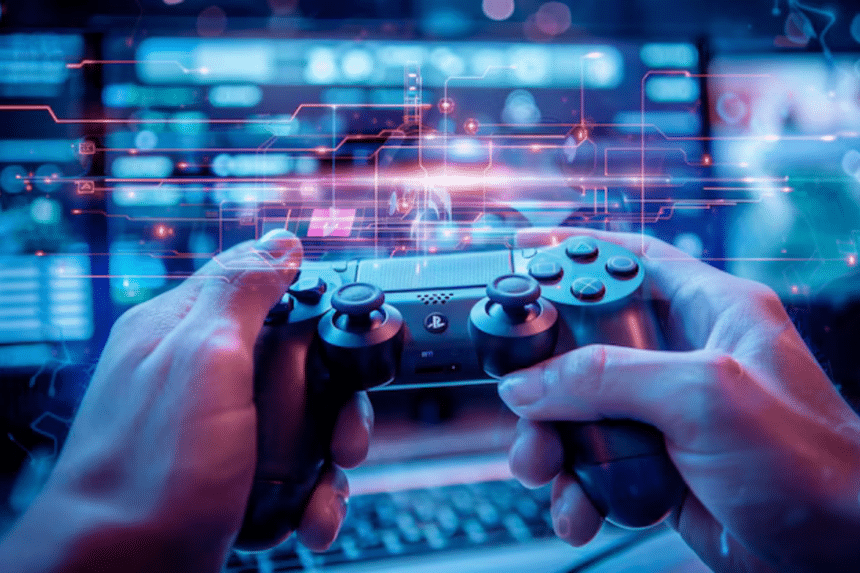
What is AI game development and How is it Changing the Way We Play?
We’ve all been there. You’re playing a stealth game, hiding behind a crate, and suddenly a guard doesn’t just walk his usual loop—he calls his friends, flanks you, and flushes you out with a grenade. You think, “Eh, since when did this guy get so smart?” That’s the most basic “hello” from artificial intelligence in gaming. For years, we thought AI was just a set of “If-Then” rules. If player stands here, then shoot. But lately, things have changed. When people ask what is AI game development, they aren’t just talking about a harder difficulty setting. They are talking about a whole new way of building digital universes.
In the past, a game designer had to manually place every tree, write every line of dialogue, and animate every sword swing. It’s a lot of “OT” (overtime) and manual labor. Today, AI for game design acts like a super-assistant. It’s the difference between drawing a forest leaf by leaf and planting a “seed” of code that grows a whole mountain range by itself. For us gamers in Asia, where we spend a lot of time on mobile MMOs and massive open-world titles, this tech is the reason why games are getting bigger and more complex without taking 20 years to make.
Understanding the basics: What is AI game development exactly?
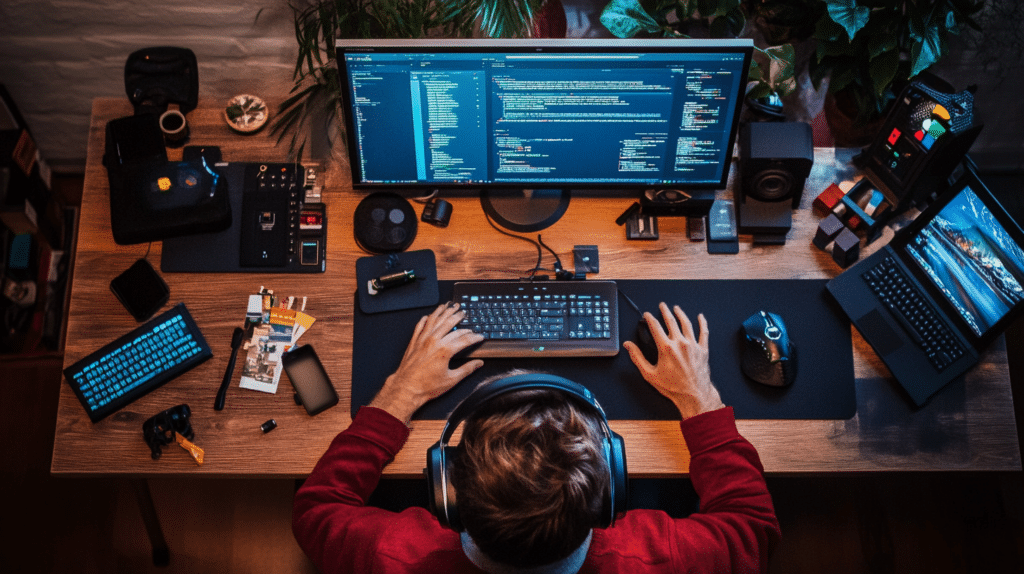
Let’s keep it simple. If traditional game dev is like building a LEGO set by following a manual, AI game development is like having a LEGO set that builds itself while you give it “vibes” and directions.
When we talk about AI game development explained to a non-tech friend, we usually look at three main areas:


- The Brains (NPCs): Non-player characters that learn from you. Instead of just standing there with a question mark over their heads, they react to your playstyle.
- The World (PCG): This is Procedural Content Generation. AI-generated game content means the game can create new levels or dungeons on the fly. You and your friend could be playing the same game but seeing totally different maps.
- The Look (Graphics): Have you heard of DLSS or frame generation? That’s AI “guessing” what the next pixel should look like so your laptop doesn’t explode while running high graphics.
Even companies that provide administrative or technical backend support, like The9bit, are seeing how these shifts require more organized data management. It’s no longer just about the art; it’s about managing the “logic” that creates the art.
How AI is used in game development to stop the “Grind”
If you’ve ever followed game news, you know that “crunch culture” is a big problem. Devs stay up all night fixing bugs or painting textures. This is where the benefits of AI in game development really kick in for the people behind the screen.


Take AI game testing automation for example. Usually, a human has to run into a wall 1,000 times to see if they fall through the map. Now, devs can unleash 1,000 “AI agents” to play the game at 10x speed. These bots find the bugs in an hour that would take a human a week to find.
Then there’s AI storytelling in games. Imagine talking to an NPC in an RPG, and instead of choosing from three pre-written lines (A, B, or C), you can actually type or speak to them. The AI generates a response that fits the character’s personality and the story’s lore. It makes the world feel alive, like you’re actually part of a living community, not just clicking through a script. This is the heart of AI game design basics—using tech to bridge the gap between “machine” and “immersion.”
Is this going to make games feel “soulless”?

This is the “kopitiam” (coffee shop) debate of the year. Some people worry that if we use AI for game design, every game will start looking the same, like those weird AI-generated photos with seven fingers.
But if you talk to industry insiders, they see it differently. They see it as a tool, like Photoshop or a calculator. AI in game development isn’t here to replace the artist; it’s here to do the boring stuff so the artist can focus on the “soul.”


For example, an artist might use AI to generate 50 different types of “rock textures” in seconds. They then pick the best one and refine it. Without AI, they’d spend three days drawing rocks. Which one sounds better? Most would say the one where the artist gets to spend more time on the main character’s emotions and the plot twists.
The Core Insight
Key TakeawayEfficiency Over Replacement
The real power of AI in game development lies in “Asset Prototyping.” By using AI-generated game content for background elements, studios can cut production costs by up to 30%, allowing indie developers to compete with AAA giants.
What does the future of play look like for us?
So, where is this all going? If you look at the trajectory of how AI is used in game development, we are moving toward “Personalized Gaming.”
Imagine a game that knows you’re a busy working adult in KL or SG who only has 30 minutes to play at night. The AI could adjust the quest length or difficulty so you actually feel a sense of achievement before you sleep. Or, if the AI sees you’re struggling with a boss, it might subtly change the boss’s pattern—not to make it “easy,” but to keep it fun for you.
This isn’t sci-fi anymore. Tools used by groups like The9bit to streamline digital operations are just the tip of the iceberg. As AI game development explained above shows, the tech is becoming invisible. Soon, we won’t even call it “AI gaming.” It’ll just be “gaming”—more immersive, more responsive, and way more “infinite” than we ever dreamed.
Official Website: https://the9bit.com/
Curious about the tech behind your favorite games?
AI Game Dev FAQBreaking down the most common questions about the future of gaming and AI.