
No Code, No Problem: How an AI Game Development Platform Is Letting Regular People Build, Play, and Actually Earn in 2026
Recently, you might have seen more people across Malaysia and Southeast Asia talking about using an AI game development platform to build their own projects. You’ll hear things like “I built this without writing a single line of code,” and it’s making people wonder if the tech barrier has finally disappeared.
- What Does an AI Game Development Platform Actually Do for You?
- If You’ve Never Built Anything — Here’s How People Are Using the AIGD Platform as Beginners
- Can You Actually Earn Money from Games Built on an AI Game Development Platform?
- Where Is the AI Game Development Platform Space Headed — And Why Does It Matter Now?
It’s not magic—think of it like voice assistants. You used to have to type perfectly; now you just talk naturally. Modern tools don’t ask you to master Unity or C#; you simply describe your idea—like a puzzle game or a 2D platformer—and the system builds a playable prototype.
With a modern AI game generator, the “how” is handled by the tech, letting you focus entirely on your creativity. From Rosebud AI to Jabali AI, going from a text prompt to a working game in minutes is now a reality for any beginner.
What Does an AI Game Development Platform Actually Do for You?

Let’s break this down without the buzzwords.


When most people imagine building a game, they picture someone hunched over lines of code for months. The reality now — especially if you’re using the right AI game maker platform — is more like directing a project than engineering it.
You make decisions. You describe characters, environments, rules. The AI handles the technical execution.


Specifically, modern platforms handle things like:
Asset generation — backgrounds, sprites, animations, sound effects. What used to require a graphic designer and an audio person can now come from a few text prompts. Ludo.ai, for example, is well known for generating character spritesheets and animation presets that small teams used to spend weeks producing.
Game logic and mechanics — the “if this happens, then that happens” backbone of every game. AI coding assistants suggest this logic automatically based on the genre you’ve chosen and the behaviour you describe.
Testing and iteration — best AI game development tools 2026 can simulate thousands of play scenarios to catch bugs that would have slipped past a small team. This alone used to be a major bottleneck.


So when people ask what is the best platform to use AI for game development, the honest answer is: it depends on what stage you’re at. Beginners wanting a pure no-code experience will lean toward platforms like Rosebud or SEELE. Developers who already know a bit of scripting might use AI-assisted tools inside Unity or Unreal Engine to go faster. There’s a whole spectrum.
What they all have in common is that they’re making the “how do I even start” problem a lot smaller.
If You’ve Never Built Anything — Here’s How People Are Using the AIGD Platform as Beginners
Imagine you’re not a developer. You play mobile games casually. You’ve got an idea for a simple trivia game themed around Malaysian street food. Where do you even begin?
A few years ago, the honest answer was “find a developer and explain your idea to them, then spend money and wait.” Today, the process looks more like this:
You open a browser-based AI game generator tool. You type: “A trivia game with 10 questions about Malaysian food. Players earn points for each correct answer. Simple visuals.” The platform gives you a working prototype. You play it, adjust the questions, change the color scheme, tweak the timer. Within a session, you’ve got something you could actually share.
That’s exactly the experience platforms like GDevelop and SEELE are built around — and it’s what people mean when they say create games with AI no coding isn’t just a slogan anymore.
The important thing to understand for beginners is that you’re not replacing the creative work. The AI doesn’t decide what makes your game fun or interesting — you do. What it eliminates is the technical barrier between your idea and the screen. For how to make a game with AI for beginners, the real learning curve is about iteration: play your own game, notice what feels off, adjust. Repeat. That process is now genuinely accessible.
One practical note: if your game has more complex mechanics or you want multiplayer features, you’ll hit a wall with the simplest tools. That’s when something with more depth — or support from a platform partner like The9Bit, which provides administrative and structural support for indie creators — becomes useful for navigating the next step.
The Core Insight
Key TakeawaySpeed Is the Real Barrier-Breaker
According to a 2024 controlled study by researchers from Stanford University and MIT, developers using AI coding assistants completed programming tasks up to 55% faster compared to those working without AI support. On an AI game development platform, this speed advantage compounds — beginners ship prototypes in hours, not months, making “test your idea first” the new default.
Can You Actually Earn Money from Games Built on an AI Game Development Platform?
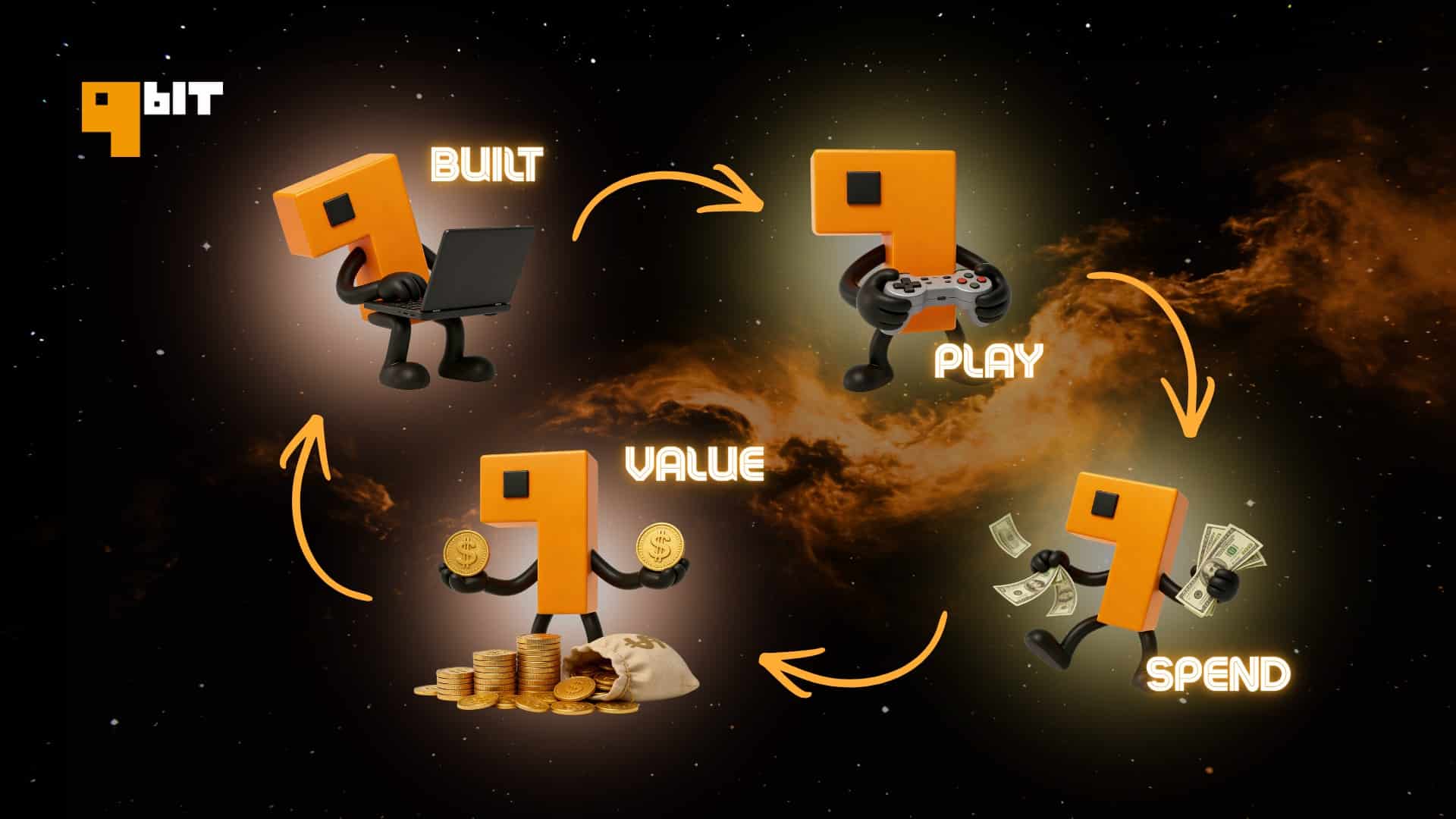
This is the question that gets the most attention — and honestly, it deserves a straight answer instead of hype.
Yes, there are real paths to earning. But they don’t all look the same.
The most talked-about model right now is the play to earn game development AI space, where games are built on blockchain infrastructure. Players earn tokens or NFTs through gameplay — completing quests, winning battles, reaching milestones. Those assets can then be traded or converted to real money. Axie Infinity is probably the best-known example of this. At its peak, players in the Philippines and Vietnam were generating meaningful income from daily gameplay. The Sandbox operates on a similar logic, where players own virtual land and assets they can actually sell.
But blockchain isn’t the only earning model. If you build a game and publish it through web platforms or app stores, standard monetisation applies — in-app purchases, ads, subscriptions, licensing. The difference now is that an AI game creator earn rewards framework makes it realistic for a solo creator to actually get something to market without a six-figure development budget.
For Southeast Asia specifically, this matters. The AI game development platform Southeast Asia conversation is growing because the region has a large, engaged mobile gaming audience and a creator community that’s increasingly comfortable building in public and monetising through digital platforms. The infrastructure — app stores, crypto wallets, local payment gateways — is already there.
The caveat worth saying out loud: earn money making games with AI is possible, but it’s not passive. The game still needs to be good enough that people want to play it. AI helps you build it faster — it doesn’t guarantee an audience.
Where Is the AI Game Development Platform Space Headed — And Why Does It Matter Now?

Here’s what’s actually happening in 2026: the line between “creator” and “developer” is blurring in a way that wasn’t true even three years ago.
The AIGD platform category — shorthand for AI-powered game development tools — has expanded to the point where the real competition isn’t about who has the best engine anymore. It’s about who has the best creative instincts and the most interesting ideas. The technical part is increasingly solved. The human part — the narrative, the feel, the thing that makes someone tell their friend about your game — that’s what differentiates products now.
Tools like the AI game generator category on platforms like Futurepedia now lists dozens of options covering everything from 3D model generation to dynamic NPC dialogue systems. The ecosystem is maturing fast. Best AI game development tools 2026 lists look meaningfully different from what they looked like eighteen months ago — more specialised, more integrated, and more accessible at the entry level.
For anyone sitting on the fence about whether this space is worth exploring: the barrier to trying is basically zero. Most of these platforms offer free tiers. You can go from “curious” to “I’ve made a thing” within an afternoon. Whether that thing becomes a revenue stream, a portfolio piece, or just a fun experiment — that’s up to you. But the option is now genuinely open, in a way it wasn’t before.
That’s the real shift. Not just better tools — a different relationship between regular people and the act of building something that others can play.
Official Website: https://the9bit.com/
Do you really need zero skills to use an AI game development platform?
AI Game DevReal questions from people just getting into the space — with answers that don’t oversell the idea.